Cell Biology & Immunology Laboratory
Cell Biology & Immunology
Autoimmune Sensorineural Hearing Loss
Our primary interest in auditory science is to elucidate the mechanisms of antibody induced hearing loss and to develop a better understanding of autoimmune hearing loss in patients.
Animal Model of Antibody Mediated Hearing Loss
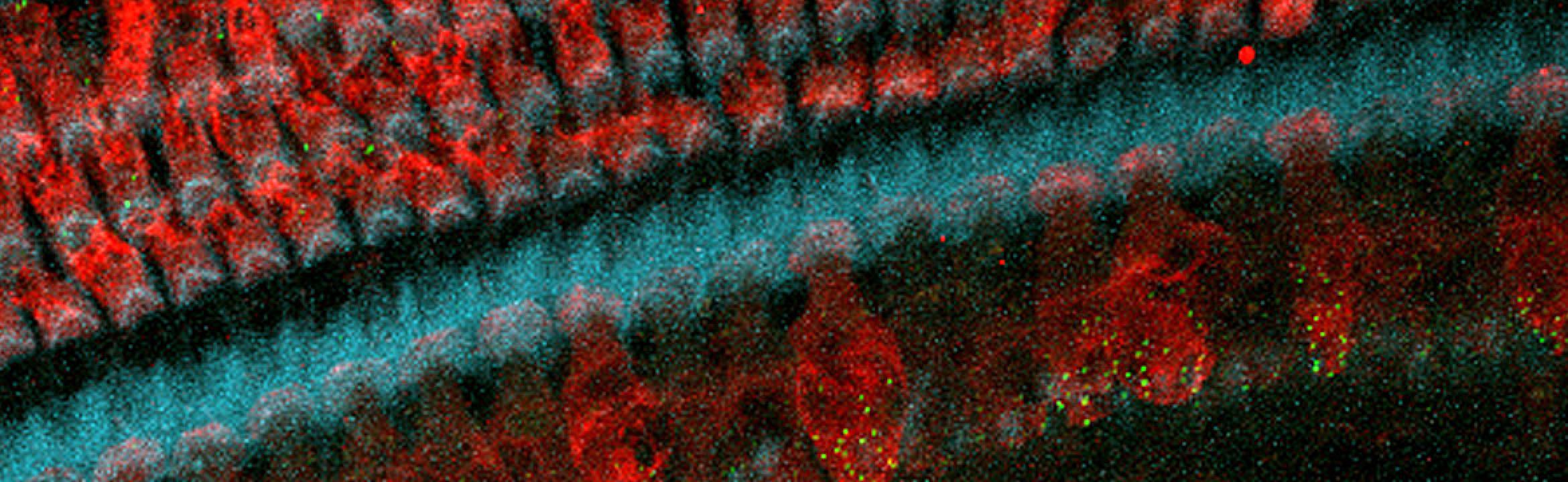
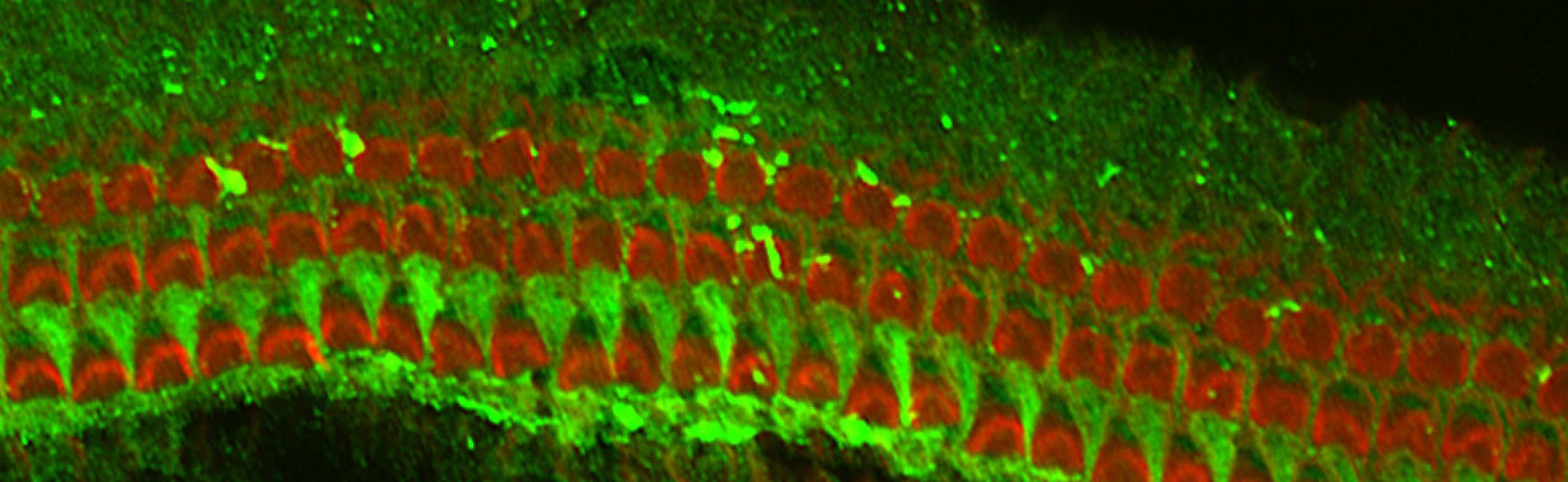
We developed a monoclonal antibody, KHRI-3, that binds to a prominent supporting cell antigen as part of a project to define unique proteins expressed in the inner ear (Zajic et al, Hearing Research 1991).
Figure 1: Confocal images of KHRI-3 staining of supporting cells
In the course of analyzing this novel protein we discovered that mice carrying the KHRI-3 hybridoma that develop high circulating antibody titers also suffer loss of hair cells in the basal turn of the cochlea and high frequency hearing loss (Nair et al. Hearing Research 1995). That the antibody binds to supporting cells in vivo and causes the hearing loss and damage to the organ of Corti has been confirmed by infusion of highly purified antibody into the cochlea of Guinea pigs.
Figure 2: In vivo binding of KHRI-3 to supporting cells
(Nair et al. Hearing Research 1997)
We are currently studying the mechanism of hearing loss in animals. It appears that the staining pattern changes with scar formation and each hair cell scar exhibits a circular or oblong KHRI-3 staining pattern.
Figure 3: Co-localization of scar formation and altered KHRI-3 expression
(Nair et al. Hearing Research 1999)
We are currently working to isolate, purify, and sequence the inner ear target protein.
Evidence for Supporting Cell Antibodies in Sera from Hearing Loss Patients
Based on our studies in guinea pigs we developed assays to detect inner ear antibodies in sera from patients suspected of having autoimmune hearing loss. We used guinea pig tissues as substrate based on the concept that the antigen might be conserved across species. Our results showed that patients� sera contain antibodies that stain a ~68 kDa band in inner ear extracts. These sera also bind to supporting cells with a pattern similar to that of KHRI-3.
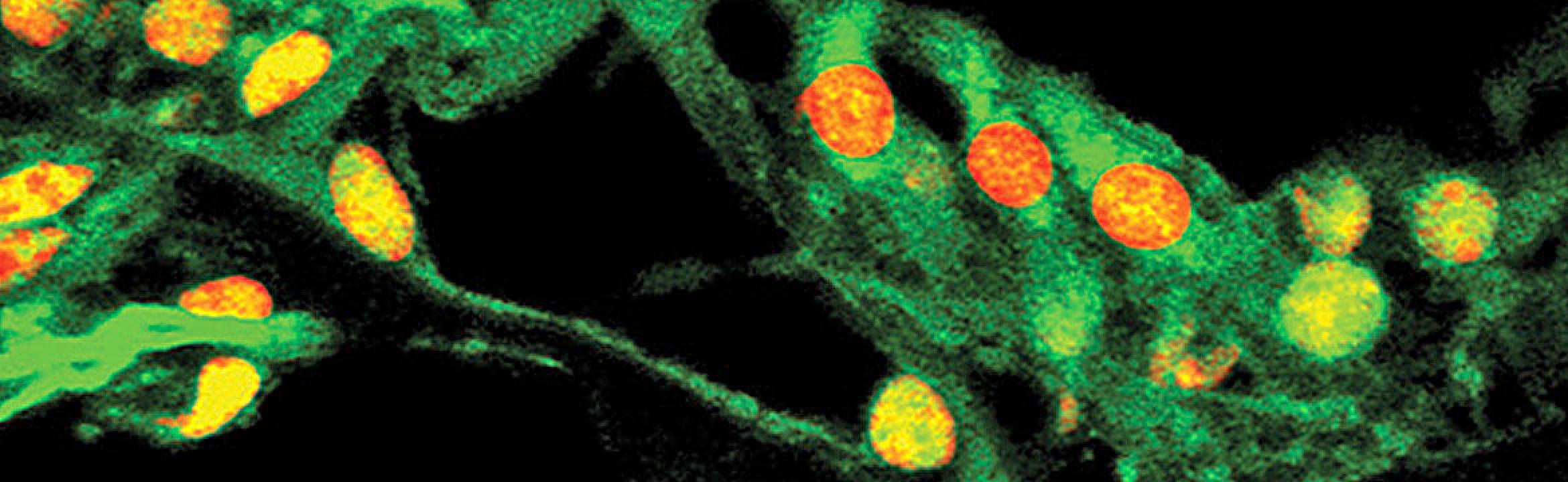
Figure 4: Confocal microscope images of fluorescent staining
of guinea pig inner ear supporting cells by sera from two patients
(Disher et al. NY Acad Sci 1997)
The antigens identified by KHRI-3 and human sera have similarities and may be the same protein. In fact, a 68-72 kDa protein precipitated by KHRI-3 is strongly stained by sera from patients with sudden onset and rapidly progressive hearing loss.
Figure 5: Staining of KHRI-3 precipitated protein by patient serum antibodies.
Note the dark band indicated by the bracket on the right side of the figure.
In this figure the western blots were performed under reducing conditions
which decreases the binding of KHRI-3 antibody but increases
the binding of human antibodies.
Using the KHRI-3 antibody we immunoaffinity purified the guinea pig inner ear supporting cell antigen. The purified antigen was sequenced with tandem mass spectrometry which identified 10 peptides that are identical in sequence to a putative human protein called CTL2, a member of the choline transporter-like family of proteins. We raised antibodies to synthetic peptides within CTL2 that are based on the identical amino acid sequence of human and guinea pig. The antibodies were used to show that CTL2 is identical to the KHRI-3 antigen (see Figures 6a, 6b, and 6c below) and that CTL2 is abundantly expressed in the human inner ear (Nair, et al., J Neurosci 24:1772-1779, 2004).
Figure 6: KHRI-3 and rabbit anti-CTL2 identify the same protein.
Figure 6a: IF staining of guinea pig organ of Corti,
KHRI-3 (left), CTL2 antibody (center), 2nd antibody (right)
Figure 6b: KHRI-3 IP of guinea pig inner ear
blotted with KHRI-3 (left) or CTL2 antisera (rabbit 228 middle; 229 right)
Figure 6c: Reciprocal IP and WB. WB with KHRI-3 (left) and WB anti-CTL2 (rabbit 229, right).
IPs:
Lane 1: whole cell lysate (WCL)
Lane 2: KHRI-3IP
Lane 3: anti-CTL2 IP
Lane 4: mock IP with non-immune mouse (left) or rabbit (right) IgG
CTL2 contains 10-11 transmembrane domains, and has characteristics of transporter proteins. A proposed transmembrane structure for the CTL2 protein is shown in Figure 7 below:
Figure 7: Predicted transmembrane structure of CTL2 (with exon 1a transcribed from the upstream promoter (1) showing 10 peptides sequenced by tandem mass spectrometry, the synthesized peptides (in blue), and the predicted locations of the extracellular N-linked carbohydrate modifications.
We postulate that antibody binding to extracellular domains of this molecule can disrupt its function and that its function is required for auditory hair cell survival. We are now testing whether patients with autoimmune hearing loss have antibodies to CTL2, by expressing CTL2 in cultured cells and using those cells as targets for antibody binding. If CTL2 is a prominent antigen in autoimmune hearing loss then we should be able to develop an accurate test for diagnosis and management of autoimmune hearing loss.